When: Thursday, June 10 and Friday, June 11, 2010
Where: Fredericton,
New Brunswick, Canada
Location: Gillin Hall,
540 Windsor Street, Room GC-127
Aims and Scope
This workshop explores recent progress and open problems in optimal approaches for storage, retrieval and dynamic updating of spatial data in a networked environment. Topics to be addressed include
- The design of spatial data structures and algorithms for geographic information systems that have as low a memory footprint as possible and still allow operations such as node addition and removal, node locking, and range queries to be performed efficiently.
- I/O aware spatial data structures that are sensitive to varying access costs across the memory hierarchy, including issues related to the cost of distributed, remote and secondary storage.
- Caching strategies for distributed spatial data structures that to coordinate paging of indexing structures in order to reduce external (network or disk) accesses given changes in user requests.
- Issues of consistency, replication and recoverability in distributed massive spatial data structures.
- Data management and organization of geo-spatial data in ways that maintain efficiency of access, accuracy of data, as well as the ability to distribute the data.
- Design of data structures for storing massive amounts of data that can be readily distributed over a network.
Workshop sponsored by:






Participation by invitation, registration by June 1, 2010.
Schedule
Thursday, June 10, 2010
8:00 to 8:30 a.m. Registration
8:30 a.m. Welcome and opening remarks
Greg Kealey, UNB Provost and Vice-President (Research)
Alex Lopez-Ortiz, Brad Nickerson
9:00 a.m. Opening Talk by Peyman Afshani,
Recent Developments on Orthogonal Range Reporting
discussion of research issues raised
10:00 a.m. Refreshment Break
10:30 a.m. Meng He,
Succinct Geometric Indexes Supporting Point Location Queries
10:50 a.m. Stephane Durocher,
Topology Control in Wireless Networks: Minimizing the Maximum Overlap
in a Connected Disc Graph
11:10 a.m. Gautam K. Das,
I/O-efficient Triangular Range Search and Its Application
11:30 a.m. Discussion Session
12:00 noon - lunch
1:00 p.m. Thuy Thi Thu Le,
A Dynamic Data Structure Indexing Bounded Lines for Efficient
Range Search
1:20 p.m. Patrick Nicholson,
Experiments on Range Searching over Untangled Monotonic Chains
1:40 p.m. Francisco Claude,
Decomposing Points into Non-crossing Monotonic Descending Chains
2:00 p.m. TBD ,
TBD
2:20 p.m. Discussion Session
3:00 p.m. refreshment break
3:30 p.m. Matthew Skala,
A Geometric View of Partial Order Embedding
3:50 p.m. Alejandro Salinger,
Practical Discrete Unit Disk Cover Using an Exact Line-Separable
Algorithm
4:10 p.m. Robert Fraser,
Computing the Hausdorff Core of Simple Polygons
4:30 p.m. Discussion Session
5:00 p.m. depart UNB for Beaverbrook Art Gallery
5:30 p.m. guided tour of Beaverbrook Art Gallery
6:30 p.m. dinner at Beaverbrook Art Gallery
Friday, June 11, 2010
9:00 a.m. Norbert Zeh,
Improved Bounds for Cache-Oblivious Range Reporting
9:20 a.m. Chris Hamilton,
CO Range Reporting With Optimal Queries Requires Superlinear Space
9:40 a.m. Discussion Session
10:00 a.m. refreshment break
10:15 a.m. transportation (by rented bus) to CARIS facilities
10:30 a.m. CARIS "ping to chart" demo
active discussion (up to 30 minutes) of open problems
12:00 noon - lunch, at CARIS facilities
1:00 p.m. Mark Masry
and Todd Jellett,
Spatial Data in Practice: An Overview of Applied Problems
1:40 p.m. Konstantinos Tsakalidis,
Dynamic Planar Orthogonal 3-sided Range Reporting in Expected Doubly
Logarithmic Time
2:30 p.m. refreshment break
3:00 p.m. Stuart MacGillivray,
Examining the I/O-Efficiency of Range Search on the Linear-Space
Multi-Level Grid File
3:20 p.m. Masud Hasan,
Spatio Temporal Data Patterns: Recent Results and Future Directions
3:40 p.m. Discussion Session
4:00 p.m. workshop wrap-up
4:15 p.m. transportation back to UNB
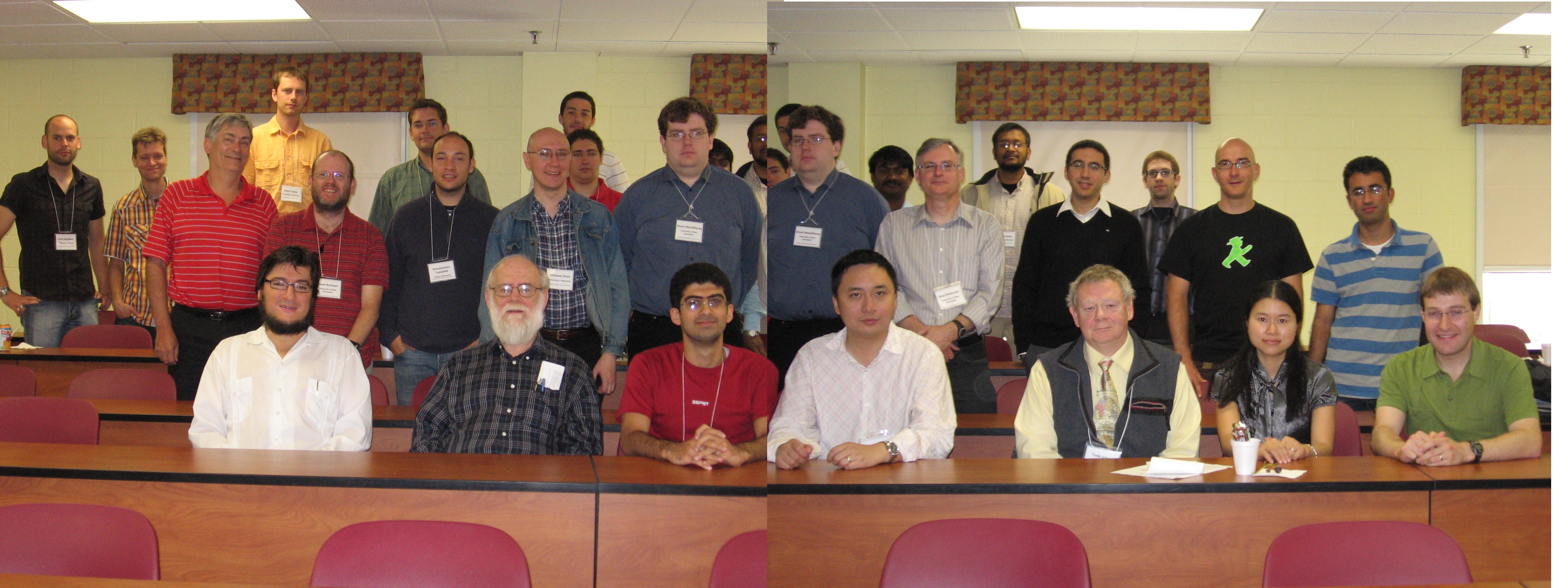
Group picture
of workshop participants taken on June 11, 2010.
Last Revised: June 18, 2010, Brad Nickerson